
Shuffleboard: The Complete Guide for Venue Operators
Last reviewed: August 2026
Shuffleboard is a social game in which players slide weighted pucks towards scoring areas, using accuracy and strategy to outscore their opponents. The basic idea is simple, but the opportunity to block shots, displace opposing pucks and compete in teams gives the game lasting appeal.
For venue operators asking what shuffleboard is and why it appears in so many modern bars and entertainment spaces, its popularity comes down to accessibility. Guests can understand the basic objective quickly, groups can play together and the game fits naturally alongside food, drinks and conversation.
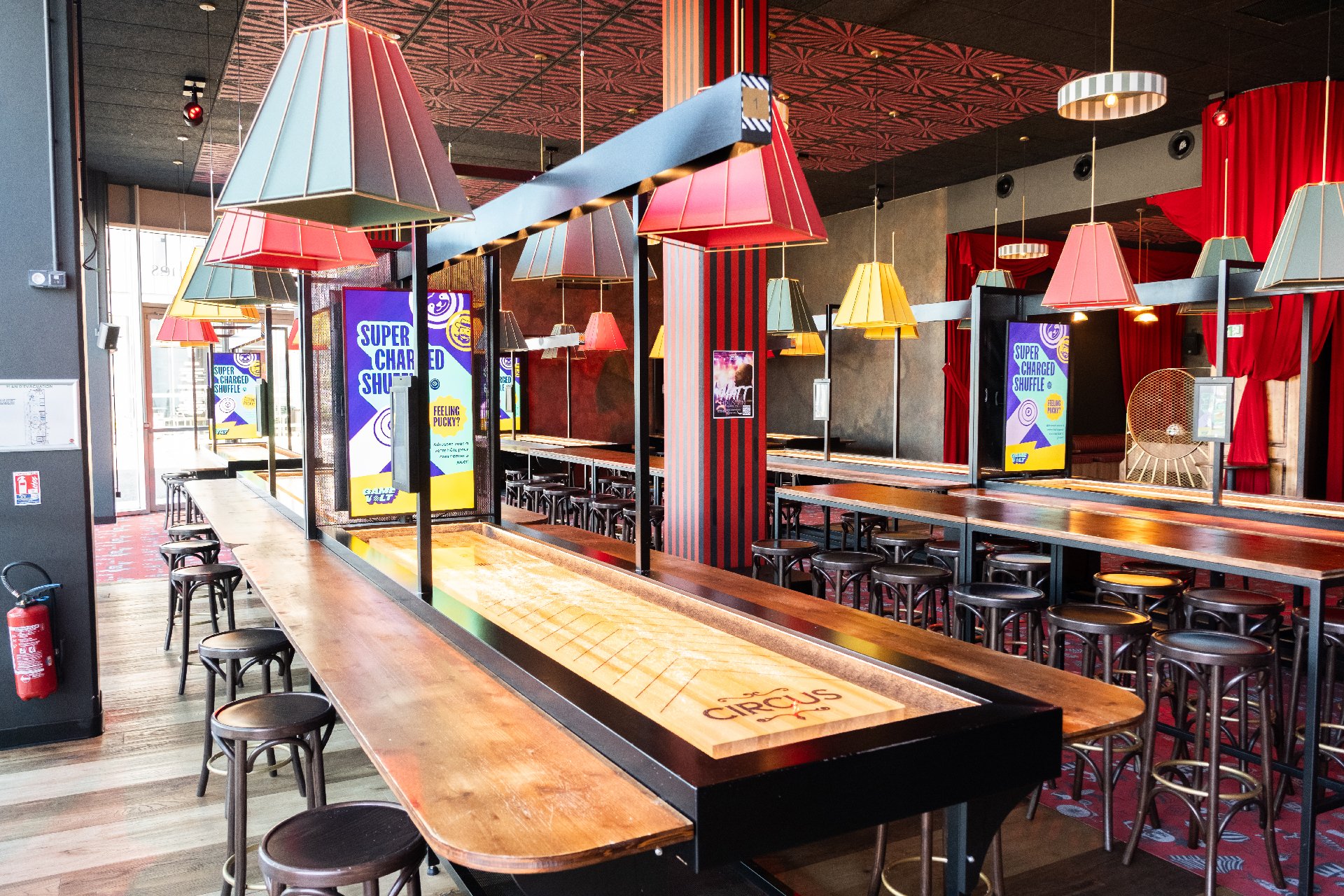
The shuffleboard game now exists in several forms. Traditional table shuffleboard remains a familiar sight in pubs and bars, while outdoor shuffleboard is played across a marked court. Interactive systems such as Supercharged Shuffle retain the physical pucks and playing surface but add automated scoring, responsive visuals and different game modes.
This shuffleboard guide explains how the game works, the formats available and why operators continue to invest in it as a commercial attraction.
What is shuffleboard?
Shuffleboard is a game of accuracy, positioning and controlled force. Players slide pucks towards marked scoring zones, attempting to finish in valuable positions while preventing their opponents from doing the same.
The name can describe several related games. In table shuffleboard, players use their hands to slide pucks along a smooth wooden playing surface. In outdoor or deck shuffleboard, players use cues to push discs across a marked court. Both formats share the same broad principle: place your pieces in scoring positions and disrupt your opponent’s attempts.
When people ask “what is shuffle board?” in relation to a bar or entertainment venue, they are usually referring to table shuffleboard. This version is compact enough for indoor venues and naturally supports head-to-head or team competition.
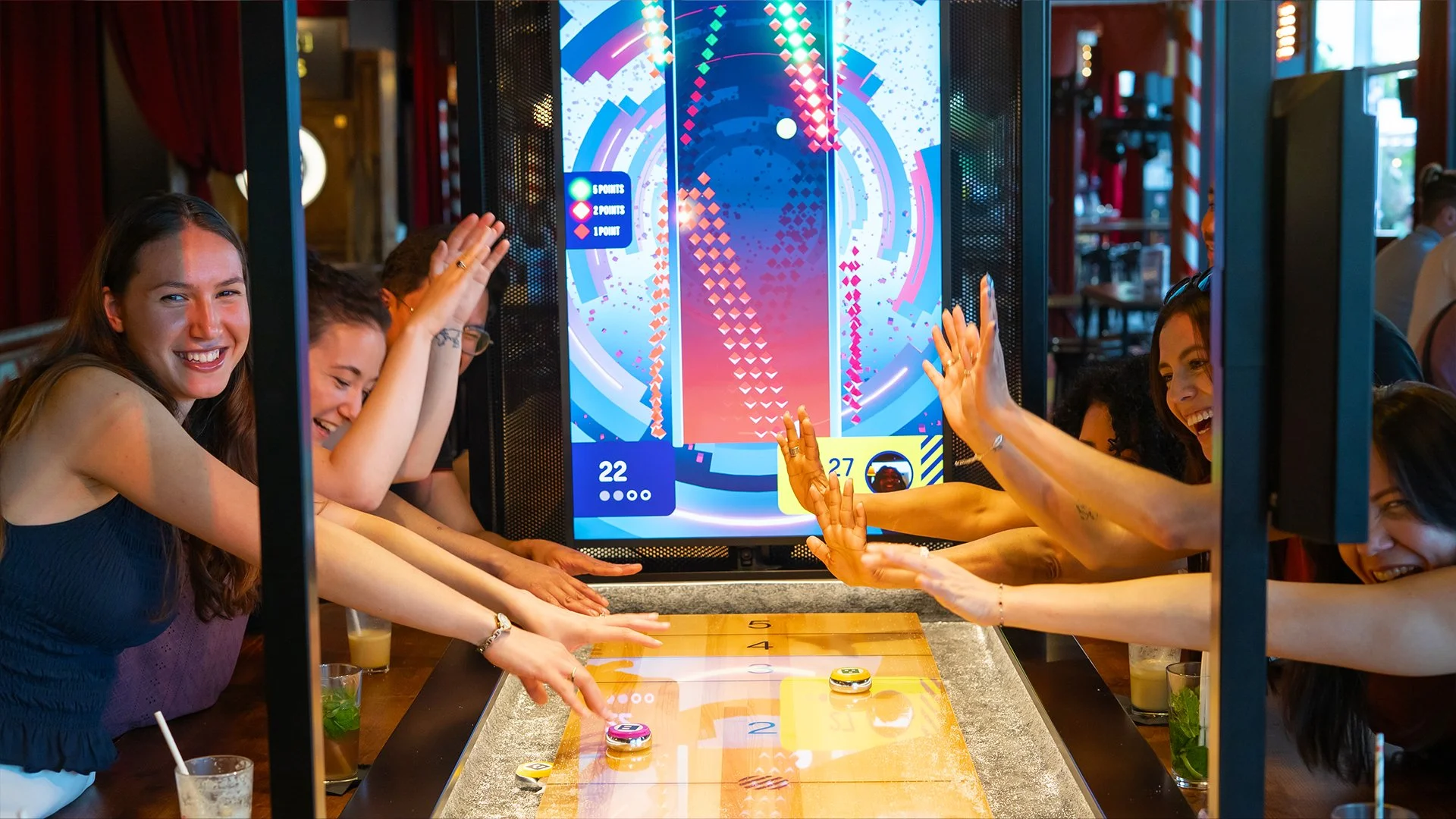
Modern interactive shuffleboard adds a digital layer to the physical game. Supercharged Shuffle uses patented tracking technology to follow each puck, calculate scores automatically and respond to shots with video game visuals. Players still control every physical shot, but the system manages the scoring and brings additional objectives into play.
How does shuffleboard work?
A shuffleboard game is played by sliding pucks from one end of the table towards scoring zones at the opposite end. Players or teams take turns, aiming to place their pucks in strong positions while knocking opposing pucks into lower-scoring areas or off the playing surface.
Control matters more than raw power. A shot that travels too far may leave the scoring area completely, while one that stops short may fail to score. Players must judge the speed of the surface, the weight of the puck and the position of every previous shot.
Traditional table shuffleboard normally follows this basic sequence:
Players or teams choose their pucks.
Opponents take turns sliding one puck at a time.
Players attempt to reach the scoring area and disrupt opposing shots.
Scores are calculated after the round.
Further rounds continue until the agreed winning score or session time is reached.
Exact scoring rules can vary between tables, venues and game formats. Operators should therefore give guests a short explanation before play or display the rules clearly near the table.
Interactive shuffleboard makes this process easier for new players. Supercharged Shuffle tracks the position of each puck and calculates the score automatically. On-screen visuals show how each shot affects the game, removing the need for players to record points themselves or ask staff to resolve close scoring decisions.
What are the different types of shuffleboard?
The main types of shuffleboard are table shuffleboard, outdoor shuffleboard and interactive shuffleboard. Each format is based on sliding pucks or discs towards scoring areas, but the equipment, playing space and guest experience differ considerably.
For venue operators, table and interactive shuffleboard are usually the most relevant options. Both can support indoor group play, although interactive systems provide more game variety and automated operation.
Table shuffleboard
Table shuffleboard is played by sliding weighted pucks along a smooth, narrow table towards scoring zones at the opposite end. Players take turns and attempt to finish with their pucks further along the table than those of the opposing player or team.
The shuffleboard table uses a polished playing surface designed to help the pucks travel smoothly. Shuffleboard wax, sometimes called sand or powder, is commonly applied to control speed and reduce friction.
Table shuffleboard is well suited to pubs, bars and entertainment venues because guests play from one end of the table and do not need specialist clothing or equipment. The game also allows players to talk, eat and drink between shots, making it a natural fit for hospitality settings.
Traditional shuffle board tables come in different lengths. Operators need to consider the dimensions of the table alongside the additional space required for players, circulation and any nearby food and drink service.
Outdoor shuffleboard
Outdoor shuffleboard, also known as deck or court shuffleboard, is played across a marked surface rather than a raised table. Players use long cues to push flat discs towards scoring areas at the opposite end of the court.
The larger playing area makes outdoor shuffleboard suitable for resorts, cruise ships, holiday parks and leisure spaces with enough available room. It has a slower, more relaxed style of play than many indoor competitive socialising activities.
Outdoor shuffleboard requires a level court and enough clearance for players to move around safely. Operators also need to consider lighting, weather exposure, surface maintenance and how frequently the court is likely to be used throughout the year.
Although table and outdoor shuffleboards share the same broad objective, they are distinct experiences. Table shuffleboard uses hand-slid pucks and occupies a smaller indoor footprint, while outdoor shuffleboard uses cues, discs and a full-length court.
Electronic and interactive shuffleboard
Interactive shuffleboard combines a physical shuffleboard table with digital tracking, automated scoring and responsive media. Players still slide real pucks and control every shot, but technology follows the action and changes what happens on screen.
Supercharged Shuffle uses patented tracking technology to monitor the pucks and calculate scores automatically. The system includes five game modes, allowing players to experience different objectives through the same table:
Shuffle Reloaded develops the familiar rules of classic shuffleboard.
Wave Breaker challenges players to smash virtual gems and build combinations.
Danger Zone introduces areas that players must avoid.
Hoarders allows teams to collect and steal virtual gems.
Cluster Puck asks players to finish close to a virtual jack while disrupting opposing shots.
Action replays add another layer to the experience by showing memorable moments back to the group. Selfie onboarding helps identify the players at the beginning of a session, while automated scoring removes the need to calculate points manually.
Interactive shuffleboard is particularly relevant to venues that want to sell bookable sessions rather than provide a passive walk-up game. Multiple game modes give returning guests more reasons to play again without requiring the operator to install another physical attraction.
Why is shuffleboard popular in entertainment venues?
Shuffleboard is popular in entertainment venues because it combines simple physical gameplay with direct social competition. Most guests can understand the objective after a short explanation, but accuracy and tactical decisions leave room for players to improve.
The pace of the game also supports social interaction. Players take turns rather than competing simultaneously, giving groups time to talk, react to shots and enjoy food or drinks around the table. This makes shuffleboard well suited to dates, work socials, family visits and celebrations.
Several characteristics contribute to its commercial appeal:
New players can join quickly
Shuffleboard has a low barrier to entry. Guests do not need previous experience, specialist footwear or a high level of physical fitness. A new player can take a meaningful shot within minutes of arriving at the table.
This reduces the amount of instruction staff need to provide and makes the game suitable for groups containing different ages, abilities and levels of confidence.
The game encourages group interaction
Every shot can change the position of several pucks. A player may improve their own score, protect a teammate’s puck or knock an opponent out of contention.
These visible changes give the whole group something to discuss and react to. Players remain involved even while waiting for their turn, helping the shuffleboard game create a shared experience rather than a sequence of isolated individual attempts.
Shuffleboard works alongside hospitality
Shuffleboard does not demand constant physical activity. Guests can step away between turns, collect a drink or share food without losing track of the game.
For venues, this creates a close relationship between gameplay and hospitality spend. Pucks Paris reported that players naturally ordered drinks and shared food around its Supercharged Shuffle tables, contributing to dwell time that exceeded the operator’s expectations.
It suits several types of visit
The same shuffleboard setup can serve different groups throughout the week. Couples may play casually, friends may compete in teams and corporate groups may use the game as part of an organised social event.
Interactive formats extend this flexibility by offering different game modes. A venue can provide a recognisable classic format for first-time visitors alongside more visually driven games for returning guests and organised groups.
Spectators can follow the action
Shuffleboard is easy to watch because the pucks remain visible on the playing surface. Guests can see who is in a strong position and how each new shot changes the round.
Interactive shuffleboard makes the action more visible through on-screen scoring, responsive media and replays. This can turn the table into a focal point for nearby guests as well as the people taking part.
What are the benefits of shuffleboard for venue operators?
Shuffleboard gives venue operators an accessible group activity that can support bookings, longer visits and food and drink spend. Its commercial value comes from the way guests use the attraction, not simply from the presence of the table.
The strongest results depend on the venue’s pricing, audience, location and operating model. However, several characteristics make shuffleboard commercially attractive across bars, family entertainment centres and competitive socialising venues.
Group bookings
Shuffleboard works naturally as a group activity because players can compete individually or in teams. Venues can include the game within birthday packages, corporate events, date-night offers and larger social bookings.
Supercharged Shuffle supports up to 10 players. This allows operators to accommodate larger groups around one attraction and calculate pricing by table, session or player.
Guest dwell time
A shuffleboard session gives guests a reason to remain in the venue for a set period. Because players take turns, the experience also allows time for conversation, food and drinks.
Pucks Paris reported that dwell time exceeded expectations following the installation of Supercharged Shuffle. The operator also found that players naturally ordered drinks and shared food during their games.
Secondary spend
Gameplay and hospitality can take place together around a shuffleboard table. Guests do not need to leave the attraction completely to socialise, watch another player or have a drink between turns.
Operators can support this behaviour through table service, drinks shelves, nearby seating and food packages connected to the booking. The exact effect should be measured through average food and drink spend per gaming session.
Broad audience appeal
Shuffleboard does not rely on strength, speed or previous gaming experience. This gives it a broader potential audience than activities with demanding physical or technical requirements.
Venues can market the same attraction to friends, families, couples, students and corporate groups. The pace can remain casual for social visits or become more competitive for organised events.
Repeat visits
Traditional shuffleboard creates replay value through competition and skill development. Players can improve their accuracy, learn defensive shots and compete against different opponents.
Interactive shuffleboard adds further variety through different game modes and objectives. Supercharged Shuffle offers five games through one table, giving guests more to try during future visits.
Operational consistency
A clear and consistent guest journey helps venues manage higher booking volumes. Staff need to be able to start sessions, explain the experience and reset the area efficiently.
Automated scoring reduces one common source of confusion. Supercharged Shuffle tracks the pucks and calculates scores without requiring staff or players to assess every position manually. Selfie onboarding and on-screen feedback also help groups follow the session.
Measurable commercial performance
Operators should monitor shuffleboard as they would any other bookable attraction. Useful measures include:
Occupancy by day and time
Revenue per available hour
Average session value
Average number of players
Food and drink spend per booking
Repeat booking rate
Staff time required per session
Technical downtime
These figures provide a more useful shuffleboard overview than total bookings alone. They show whether the attraction is using its floor space efficiently and contributing to the wider venue.
When traditional shuffleboard works best
Traditional table shuffleboard works well when a venue wants to provide a familiar game with minimal technical infrastructure. It can suit pubs, bars and social spaces where guests play casually rather than through structured bookings.
The physical table is the complete game. Operators are responsible for explaining the rules, maintaining the playing surface and deciding how scores will be recorded.
For venues with an audience that already understands the game, this simplicity may be part of the attraction.
When interactive shuffleboard works best
Interactive shuffleboard is better suited to operators who want to turn the game into a bookable entertainment experience. Automated scoring makes sessions easier for new players, while different game modes create more reasons to return.
Supercharged Shuffle combines real puck play with patented tracking technology, five game modes, action replays and capacity for up to 10 players. The physical skill remains central, but the digital system manages the scoring and responds to every shot.
Interactive systems require more planning than traditional tables. The venue must consider power, internet access, installation and technical support. These requirements should be assessed against the potential for larger group bookings, repeat play and automated operation.
Operators who are actively comparing products, prices and suppliers can read our guide to choosing a commercial shuffleboard table for a more detailed buying comparison.
How do you choose the right shuffleboard setup for a venue?
The right shuffleboard setup depends on available space, expected group sizes, guest demographics and how the venue plans to make money from the attraction. Operators should define the role of shuffleboard within the business before comparing individual tables.
A casual bar game, a pre-booked group activity and a centrepiece competitive socialising attraction each require a different approach.
Assess the available space
Measure the complete playing area rather than the shuffleboard table alone. Guests need enough room to take shots, stand around the attraction and move between the table and nearby hospitality areas.
Supercharged Shuffle measures 3,696mm long, 1,582mm wide and 2,370mm high. The final layout should provide additional clearance for players, food and drinks, staff access and safe circulation.
Operators should also consider:
Nearby walkways and emergency routes
Queuing or check-in space
Seating and drinks storage
Access for installation
Ceiling height
Power and network connections
Visibility from other parts of the venue
A floor plan review can identify operational problems before the attraction is ordered.
Understand the intended audience
Different audiences use shuffleboard in different ways. A pub may attract pairs and small groups looking for casual play, while a competitive socialising venue may receive larger bookings celebrating birthdays or work events.
Family entertainment centres need games that younger and older players can understand. Hotels and resorts may need one shuffleboard setup to serve families during the day and adult groups in the evening.
Interactive shuffleboard can support this range by offering several game modes through the same table. Operators can introduce new players through a familiar format and give returning visitors different objectives to try.
Decide between casual play and bookable sessions
Traditional shuffleboard often works well as a walk-up game. Guests can begin when the table is available and play for as long as the venue permits.
A bookable model requires more structure. Operators must decide:
How long each session lasts
Whether pricing is per table or per player
How many guests can join
How groups check in
What happens if a session starts late
How the table is reset
Whether food and drink packages are included
Supercharged Shuffle supports up to 10 players, giving operators flexibility when creating session prices and group packages.
Set clear business goals
The choice of shuffleboard should support a defined commercial objective. A venue may want to increase dwell time, attract corporate groups, improve quieter trading periods or create a new source of bookable revenue.
Each objective requires a relevant performance measure. If the goal is secondary spend, track food and drink sales connected to each session. If the goal is group business, monitor booking size, session value and corporate enquiries.
Clear goals also make it easier to compare a traditional shuffle board table with an interactive alternative. Operators can assess which option is most likely to produce the required outcome rather than choosing on appearance alone.
Consider the operational workload
A shuffleboard attraction must remain easy to run when the venue is busy. Operators should ask how much staff involvement is required at check-in, during the game and between bookings.
Traditional tables may require staff to explain the scoring system and resolve close decisions. Interactive shuffleboard automates scoring and displays the outcome of each shot, which can make the experience easier for new players to follow.
Operators should still plan for cleaning, puck management, customer support and routine maintenance. Staff training should cover both the normal guest journey and what to do if a technical issue occurs.
Check the technical requirements
Traditional table shuffleboard requires little technical infrastructure. Interactive systems need power, connectivity and access to appropriate support.
Supercharged Shuffle requires a stable voltage supply and an internet connection with a minimum bandwidth of 100 Mbps for remote access. These requirements should be checked at the proposed installation point rather than assumed from the venue’s general connectivity.
Operators should also confirm:
Who manages installation
What staff training is included
How remote support works
What happens during an internet outage
Which parts are covered by warranty
How replacement components are supplied
Whether software or support carries an ongoing cost
The right shuffleboard setup should fit the venue operationally as well as physically.
Shuffleboard FAQs
What is the difference between shuffleboard and shuffle board?
Shuffleboard and shuffle board refer to the same game. “Shuffleboard” is the standard spelling, while some people separate the words when searching for the game or a shuffle board table.
For consistency, venues should use “shuffleboard” in customer-facing copy, booking systems and game instructions.
What is table shuffleboard?
Table shuffleboard is an indoor game in which players slide weighted pucks along a smooth table towards marked scoring zones. Players aim to finish in valuable positions while knocking opposing pucks away or blocking their route.
Table shuffleboard is commonly found in bars and entertainment venues because it supports social group play within a smaller area than an outdoor shuffleboard court.
Why is shuffleboard so popular in bars?
Shuffleboard is popular in bars because it is easy to begin, naturally competitive and compatible with eating, drinking and conversation. Players take turns, allowing the rest of the group to remain involved without needing to compete continuously.
The game can serve casual customers, dates, parties and work socials. This gives operators several ways to package and promote the same attraction.
What is interactive shuffleboard?
Interactive shuffleboard combines a physical shuffleboard table and real pucks with digital tracking, automated scoring and responsive visual content.
Supercharged Shuffle follows every puck using patented tracking technology. It calculates scores automatically and includes five game modes, selfie onboarding and action replay footage. The technology enhances the physical game without replacing the player’s control of each shot.
How many types of shuffleboard are there?
The three main formats covered in this guide are table shuffleboard, outdoor or deck shuffleboard, and electronic or interactive shuffleboard.
Variations exist within each format, with different rules, court sizes and scoring systems. For venue operators, table and interactive shuffleboard are normally the most relevant indoor options.
How many people can play shuffleboard?
The number of players depends on the table, rules and venue format. Traditional shuffleboard can be played individually or in teams, with players taking turns to slide their pucks.
Supercharged Shuffle supports up to 10 players. Operators can set lower booking capacities if they want to provide more space or create shorter, faster sessions.
Is shuffleboard difficult to learn?
The basic objective of shuffleboard is easy to learn: slide the puck towards a scoring position without sending it too far. New players can normally begin after a short explanation.
Accuracy, positioning and defensive play take longer to master. This combination of simple entry and room for improvement is one reason the shuffleboard game appeals to both first-time and returning players.
Explore modern shuffleboard solutions
Shuffleboard remains popular because its central appeal has not changed. It gives people a simple physical challenge, direct competition and time to socialise around the game. For venue operators, those qualities can support group bookings, longer visits and additional food and drink spend.
Interactive shuffleboard develops that familiar format for modern entertainment venues. Supercharged Shuffle combines real puck play with automated scoring, patented tracking technology and responsive video game visuals. Five game modes, action replays and selfie onboarding create more variety through one table, while capacity for up to 10 players supports parties, corporate events and casual group visits.
Learn more about Supercharged Shuffle or speak with Game Volt about creating an interactive shuffleboard experience for your venue.