
Competitive Socialising: The Complete Guide for Venue Operators [2026]
Last reviewed: August 2026
Competitive socialising combines games, hospitality and group interaction within one venue experience. Guests visit to play activities such as interactive shuffleboard, digital shooting games, active gaming, darts, bowling, crazy golf or modern carnival games, usually alongside food and drink.
For operators, competitive socialising creates more than an additional entertainment offer. A well-designed experience can generate bookable revenue, increase dwell time, support food and beverage sales and give groups a reason to return.
The UK competitive socialising sector now includes around 800 venues, an increase of 58% since 2018. Multi-activity concepts have grown particularly quickly, reflecting a move towards venues that give guests several reasons to visit rather than relying on one fixed experience. Industry reporting based on Savills research forecasts that the market could reach approximately 1,100 UK sites by 2030.
Growth alone does not guarantee success. As the market becomes busier, operators must think carefully about location, product mix, throughput, reliability and replay value. The strongest concepts make the games, venue design and hospitality operation work together as one experience.
This guide explains what competitive socialising is, how the business model works and what operators should consider when planning or improving a venue in 2026.
What is shuffleboard?
Shuffleboard is a game of accuracy, positioning and controlled force. Players slide pucks towards marked scoring zones, attempting to finish in valuable positions while preventing their opponents from doing the same.
The name can describe several related games. In table shuffleboard, players use their hands to slide pucks along a smooth wooden playing surface. In outdoor or deck shuffleboard, players use cues to push discs across a marked court. Both formats share the same broad principle: place your pieces in scoring positions and disrupt your opponent’s attempts.
When people ask “what is shuffle board?” in relation to a bar or entertainment venue, they are usually referring to table shuffleboard. This version is compact enough for indoor venues and naturally supports head-to-head or team competition.
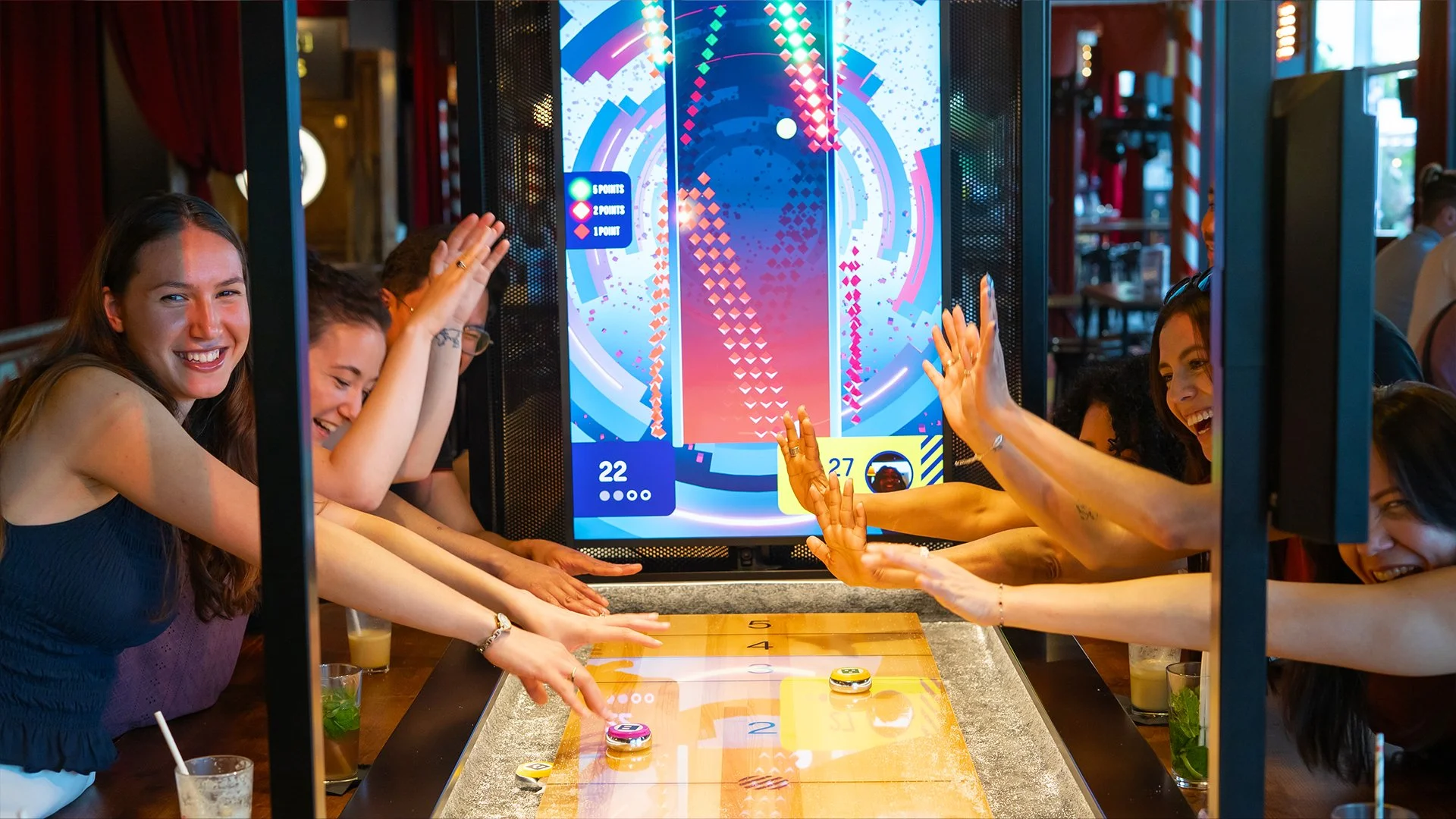
Modern interactive shuffleboard adds a digital layer to the physical game. Supercharged Shuffle uses patented tracking technology to follow each puck, calculate scores automatically and respond to shots with video game visuals. Players still control every physical shot, but the system manages the scoring and brings additional objectives into play.
How does shuffleboard work?
A shuffleboard game is played by sliding pucks from one end of the table towards scoring zones at the opposite end. Players or teams take turns, aiming to place their pucks in strong positions while knocking opposing pucks into lower-scoring areas or off the playing surface.
Control matters more than raw power. A shot that travels too far may leave the scoring area completely, while one that stops short may fail to score. Players must judge the speed of the surface, the weight of the puck and the position of every previous shot.
Traditional table shuffleboard normally follows this basic sequence:
Players or teams choose their pucks.
Opponents take turns sliding one puck at a time.
Players attempt to reach the scoring area and disrupt opposing shots.
Scores are calculated after the round.
Further rounds continue until the agreed winning score or session time is reached.
Exact scoring rules can vary between tables, venues and game formats. Operators should therefore give guests a short explanation before play or display the rules clearly near the table.
Interactive shuffleboard makes this process easier for new players. Supercharged Shuffle tracks the position of each puck and calculates the score automatically. On-screen visuals show how each shot affects the game, removing the need for players to record points themselves or ask staff to resolve close scoring decisions.
How does the competitive socialising business model work?
The competitive socialising business model combines revenue from gameplay with food, drinks, events and longer guest visits. Rather than relying entirely on walk-in hospitality spend, operators can sell an activity before the guest arrives and build the rest of the visit around it.A competitive socialising venue can generate income through:
Timed game bookings
Per-person tickets
Exclusive table, room or attraction hire
Food and drink sales
Group packages
Corporate events
Birthday and celebration packages
Tournaments and organised competitions
Peak and off-peak pricing
Full or partial venue hire
The balance between these revenue streams will depend on the type of venue. A pub introducing one interactive attraction may continue to earn most of its revenue through food and drinks. A purpose-built social gaming venue may place bookable experiences at the centre of the business model.
Bookable gameplay creates planned revenue
Timed sessions allow operators to sell the same attraction several times throughout the day. Guests choose a time, group size and activity before arriving, giving the venue greater visibility over expected demand.
The booking model also gives the visit a clear beginning and end. Operators can manage capacity, prepare for larger groups and turn the attraction over for the next session.
Pricing can be structured in several ways:
A fixed price per table or attraction
A price per player
Different rates for peak and off-peak sessions
Packages combining several games
Food and drink bundles
Minimum-spend group bookings
The best approach depends on capacity and customer behaviour. Per-table pricing can be simple for guests, while per-player pricing may generate more revenue from larger groups. Operators should model both against the minimum and maximum number of players likely to attend.
Food and drink support the gaming experience
Food and beverage should be planned around how guests play. Menus, service points and furniture need to make ordering convenient without interrupting a session.
A slower-paced game such as shuffleboard creates natural opportunities to share food and order drinks between turns. Higher-energy activities may need drinks ledges, nearby seating or a clear break between games.
Pucks Paris installed three Supercharged Shuffle tables as the basis of a venue combining interactive play with cocktails, beer and food. The venue recorded more than 3,000 user sessions after opening in April 2025, while its operator reported that dwell time and food and drink sales exceeded expectations. View the Pucks Paris case study.
Group and event bookings increase order value
Competitive socialising works well for corporate events, birthdays and celebrations because the activity gives groups a built-in structure. Guests do not need to organise their own entertainment, and the venue can package gameplay with hospitality.
Event packages may include:
Exclusive use of several game units
Team tournaments
Hosts or facilitators
Welcome drinks
Food packages
Prize presentations
Branded media or scoreboards
Private areas before or after play
Group bookings can produce higher order values than casual visits, but they also create operational demands. Venues need suitable check-in, clear session scheduling, efficient food service and enough capacity to keep every guest involved.
Repeat visits protect long-term performance
Novelty may attract a guest once, but replay value determines whether the concept remains commercially useful. Operators should look for activities with enough skill, variation or changing content to support return visits.
Repeat play can come from:
Different game modes
Improving personal performance
Competing against new opponents
Team and tournament formats
Seasonal content
Leaderboards and challenges
Trying another attraction within the venue
Super Social Dublin combines Supercharged Shuffle with The Arena, giving guests a choice between tactical table play and more active floor-and-wall games. The 15,000 sq ft venue has recorded more than 30,000 user sessions since opening in December 2024. View the Super Social case study.
What are the commercial benefits of competitive socialising?
Competitive socialising can create additional reasons to visit, generate advance bookings and increase the value of each guest session. These benefits depend on execution, particularly the choice of games, pricing, venue layout and hospitality offer.
A stronger reason to choose the venue
A game gives customers a specific answer to the question, “What shall we do?” The venue is no longer competing only on drinks, food, location or atmosphere. It offers an activity the group can choose and book together.
This changes how the visit is planned. Guests may arrange their evening around the activity, then add food and drinks before, during or after the session.
As more competitive socialising venues enter the market, the activity must still feel distinctive. Simply placing a familiar game in a bar will not always create a destination. The theme, media, service and surrounding environment all influence whether the experience feels worth travelling for.
Longer, more purposeful dwell time
Competitive socialising can extend dwell time because guests remain for the full game session and often stay for hospitality around it. Industry research places average dwell time at a competitive socialising venue at approximately 86 minutes.
Longer visits are only valuable if guests remain engaged and continue spending. Operators should avoid slow game formats, long queues or empty periods in which some members of the group have nothing to do.
Good pacing keeps the visit moving between arrival, play, food and drinks.
More predictable demand
Advance bookings give operators better visibility over staffing, stock and capacity. The venue can see when larger parties will arrive and prepare accordingly.
Pre-booked revenue also reduces reliance on spontaneous footfall. This can be particularly valuable for corporate groups, celebrations and periods when standard bar trade is less predictable.
Operators can use differential pricing to move some demand into quieter periods. Off-peak packages need to protect the value of the experience rather than simply discounting it.
Wider audience reach
Competitive socialising can attract customers who would not visit a conventional bar or arcade. Families, corporate teams, couples and mixed-age groups may all engage with an activity-led venue for different reasons.
The product mix determines how broad that appeal can become. Games requiring speed and movement may suit energetic groups, while accuracy-led games can be more accessible for mixed abilities.
Center Parcs Whinfell Forest uses four Supercharged Shuffle units alongside The Arena within its year-round Entertainment Hive. The combination provides both approachable table play and higher-energy group challenges for families and leisure guests. View the Center Parcs installation.
Stronger spectator engagement
The best competitive socialising games involve people who are not taking the current turn. Clear scoring, visible action and shared reactions keep the rest of the group engaged.
Spectator value also affects the wider venue. Glass walls around The Arena allow nearby guests to follow the action, while Hotshots uses a large projection screen to make shots visible to players and onlookers.
This visibility creates energy and can help other customers understand the experience before deciding to play.
More efficient use of floor space
Games must justify the space they occupy. Operators should compare the potential revenue of an attraction with its full operating footprint, including player clearance, waiting areas and circulation.
A smaller attraction is not automatically more efficient. Capacity, session length, throughput and price determine how much value the space can generate.
The useful measure is revenue per available hour and square metre, not simply the number of games that fit into the floor plan.
What are the benefits of shuffleboard for venue operators?
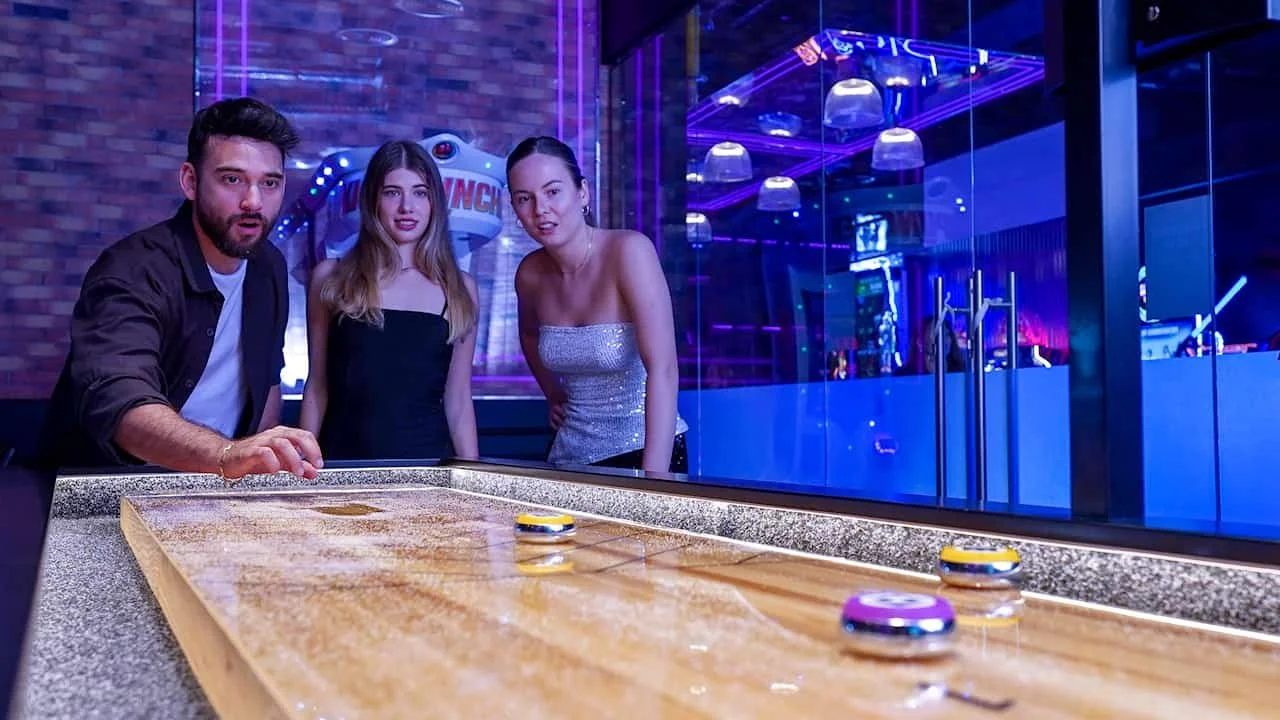
Shuffleboard gives venue operators an accessible group activity that can support bookings, longer visits and food and drink spend. Its commercial value comes from the way guests use the attraction, not simply from the presence of the table.
The strongest results depend on the venue’s pricing, audience, location and operating model. However, several characteristics make shuffleboard commercially attractive across bars, family entertainment centres and competitive socialising venues.
Group bookings
Shuffleboard works naturally as a group activity because players can compete individually or in teams. Venues can include the game within birthday packages, corporate events, date-night offers and larger social bookings.
Supercharged Shuffle supports up to 10 players. This allows operators to accommodate larger groups around one attraction and calculate pricing by table, session or player.
Guest dwell time
A shuffleboard session gives guests a reason to remain in the venue for a set period. Because players take turns, the experience also allows time for conversation, food and drinks.
Pucks Paris reported that dwell time exceeded expectations following the installation of Supercharged Shuffle. The operator also found that players naturally ordered drinks and shared food during their games.
Secondary spend
Gameplay and hospitality can take place together around a shuffleboard table. Guests do not need to leave the attraction completely to socialise, watch another player or have a drink between turns.
Operators can support this behaviour through table service, drinks shelves, nearby seating and food packages connected to the booking. The exact effect should be measured through average food and drink spend per gaming session.
Broad audience appeal
Shuffleboard does not rely on strength, speed or previous gaming experience. This gives it a broader potential audience than activities with demanding physical or technical requirements.
Venues can market the same attraction to friends, families, couples, students and corporate groups. The pace can remain casual for social visits or become more competitive for organised events.
Repeat visits
Traditional shuffleboard creates replay value through competition and skill development. Players can improve their accuracy, learn defensive shots and compete against different opponents.
Interactive shuffleboard adds further variety through different game modes and objectives. Supercharged Shuffle offers five games through one table, giving guests more to try during future visits.
Operational consistency
A clear and consistent guest journey helps venues manage higher booking volumes. Staff need to be able to start sessions, explain the experience and reset the area efficiently.
Automated scoring reduces one common source of confusion. Supercharged Shuffle tracks the pucks and calculates scores without requiring staff or players to assess every position manually. Selfie onboarding and on-screen feedback also help groups follow the session.
Measurable commercial performance
Operators should monitor shuffleboard as they would any other bookable attraction. Useful measures include:
Occupancy by day and time
Revenue per available hour
Average session value
Average number of players
Food and drink spend per booking
Repeat booking rate
Staff time required per session
Technical downtime
These figures provide a more useful shuffleboard overview than total bookings alone. They show whether the attraction is using its floor space efficiently and contributing to the wider venue.
What types of competitive socialising games are available?
Competitive socialising games range from modern versions of familiar pub activities to fully interactive group attractions. The best choice depends on audience, floor space, session length, physical intensity and the role the game will play within the wider venue.
Common formats include:
Interactive shuffleboard
Digital darts
Boutique bowling
Crazy golf
Interactive shooting
Active gaming rooms
Carnival and midway games
Karaoke
Escape rooms
Axe throwing
Batting and sports simulators
Quiz and game-show experiences
Arcade and redemption games
Operators do not need the largest possible range. A focused mix of complementary activities is usually more useful than several games serving the same audience in the same way.
Interactive shuffleboard
Interactive shuffleboard suits venues that want an accessible, recognisable activity with strong group appeal. Players can talk, eat and drink between shots, making the format compatible with hospitality.
Supercharged Shuffle keeps the physical puck play of traditional table shuffleboard while adding automated scoring, patented tracking technology and responsive visuals. It includes five game modes and supports up to 10 players.
Its pace makes it suitable for:
Bars and pubs
Competitive socialising venues
Bowling and leisure centres
Hotels and resorts
Family entertainment centres
Corporate and group bookings
Supercharged Shuffle measures 3,696mm long, 1,582mm wide and 2,370mm high. Operators must also allow room for players, drinks and circulation around the unit.
The main commercial strength of interactive shuffleboard is its broad accessibility. New players can understand the physical action quickly, while different game modes and tactical decisions support repeat visits.
Active gaming
Active gaming asks players to move, react, remember and co-operate across an interactive physical environment. It can create a higher-energy experience than turn-based table games and works particularly well as a visible centrepiece.
The Arena combines a fully interactive LED floor with two digital push-button walls, surround sound and reactive lighting. Its nine game modes include physical, mental, agility and team-based challenges.
The Arena occupies a 5m by 5m space and requires a minimum ceiling height of 4m. Glass walls allow spectators to follow the action, helping the attraction contribute energy beyond the group currently playing.
Active gaming is well suited to:
Family entertainment centres
Competitive socialising venues
Resorts and holiday parks
Mixed-age groups
Team-building sessions
Operators looking for several games within one attraction
The main operational consideration is physical intensity. Guests may not want every part of their visit to require the same level of movement, so active gaming can work well alongside a more conversational activity.
Interactive shooting
Interactive shooting combines physical target play with digital media, scoring and different game objectives. It gives players immediate feedback and can support short, competitive sessions.
Hotshots uses a large projection screen and a physical gun unit with realistic kickback. Four game modes test accuracy and reactions, while the system accommodates up to 10 players and does not require calibration.
The Hotshots unit measures 2,620mm deep, 3,810mm wide and 2,590mm high. Additional room is required for players and surrounding hospitality.
Interactive shooting can suit:
Activity bars
Bowling venues
Arcades
Family entertainment centres
Resorts
Groups seeking head-to-head competition
The projection screen makes the action visible to the wider group. This helps spectators understand who is winning and creates clear moments of success, failure and rivalry.
Operators should consider their audience and brand positioning carefully. A stylised digital shooting gallery may fit one concept naturally but feel less appropriate in another.
Connected carnival games
Carnival and midway games offer familiar physical actions such as throwing, rolling, aiming and catching. Their simplicity makes them accessible to broad audiences, while multiple units can create a shared tournament experience.
Carnival Games applies connected technology to 16 available game units. Features include responsive mechanics, social action replays, competitive balancing and team challenges.
Available game styles include:
Basketball
Ball rolling
Target throwing
Button reaction games
Catching and sorting
Moving-target challenges
The modular format allows operators to select a number of units appropriate to their space and expand the offer over time. Several games can contribute to one connected session rather than operating as unrelated standalone machines.
Carnival Games are particularly suited to:
Larger competitive socialising concepts
Multi-activity venues
Family entertainment centres
Resorts and leisure destinations
Tournament-led experiences
Venues that want scalable theming
The main advantage is variety. Groups move through different physical challenges while retaining one shared competitive structure.
How should operators build the right game mix?
A strong game mix gives guests different ways to participate without creating unnecessary operational complexity. Each attraction should have a clear role within the venue.
Operators should compare potential games across six areas.
1. Audience accessibility
A balanced venue should include experiences that first-time players can understand quickly. If every game requires specialist skill or intense physical movement, parts of the audience may disengage.
Accuracy-led games such as shuffleboard can provide an accessible entry point. Active gaming can then add a more energetic option for groups that want it.
2. Energy level
Games affect the atmosphere around them. Active attractions generate movement and noise, while table games allow more conversation.
The venue should use this contrast deliberately. Placing every high-energy experience together may create an overwhelming area, while a venue made entirely of slower activities may lack momentum.
3. Group capacity
Attractions must match the size of groups the venue expects to serve. A game with low player capacity can leave several guests watching for too long, particularly during corporate and birthday bookings.
Spectating is valuable when it remains part of the entertainment. It becomes a problem when guests feel excluded.
4. Session length and throughput
Short games can produce rapid turnover but may feel poor value if the guest journey is not packaged carefully. Longer sessions can support dwell time but reduce the number of available bookings.
Operators need to model:
Players per session
Session duration
Changeover time
Available sessions per day
Expected occupancy
Price per session
Maximum daily revenue
These calculations should use realistic utilisation rather than assuming every session will sell.
5. Replay value
A venue’s product mix should give guests a reason to return after the initial novelty has passed. Skill progression, game variety and changing competition all contribute to replay value.
Digital systems can provide several game modes through one physical attraction. Content still needs to be enjoyable, understandable and meaningfully different. More modes do not automatically create more value if they all feel alike.
6. Operational reliability
Every attraction must perform during the venue’s busiest periods. Downtime affects revenue, customer satisfaction and staff confidence.
Before selecting a product, operators should ask about:
Commercial usage history
Installation requirements
Staff training
Routine maintenance
Remote support
Replacement parts
Internet and power requirements
Warranty coverage
Software updates
Typical recovery procedures
Technology should simplify the experience for guests and staff. If it regularly demands attention, it becomes part of the operational problem rather than part of the entertainment.
How should a competitive socialising venue be designed?
A competitive socialising venue should be designed around the complete guest journey, from booking and arrival through to gameplay, hospitality and departure. Attractive interiors matter, but the layout must also support safe movement, efficient service and strong commercial use of the available space.
The games, brand, atmosphere and operating model should be developed together. Adding attractions to a finished floor plan can create awkward circulation, poor spectator views and missed opportunities for food and drink sales.
Start with the target audience
The intended customer should shape the game selection, interior style, pricing and hospitality offer.
A city-centre activity bar aimed at corporate groups may need premium finishes, strong evening hospitality and flexible event packages. A family entertainment centre requires broad accessibility, comfortable waiting areas and clear visibility for parents. A resort may need the same venue to serve families during the day and adults in the evening.
Operators should define:
Core customer groups
Typical group size
Expected visit duration
Peak trading periods
Customer spending expectations
Food and drink requirements
Accessibility needs
Reasons guests will return
This prevents the venue from becoming a collection of unrelated activities designed for different audiences.
Map the complete guest journey
A competitive socialising experience begins before the first game. Guests need to understand what they have booked, where to go and what happens next.
A typical journey includes:
Discovering the venue
Selecting an activity
Booking and paying
Receiving confirmation and arrival instructions
Entering and checking in
Waiting for the session
Learning how to play
Playing the activity
Ordering food or drinks
Moving to another game or hospitality area
Leaving, sharing or rebooking
Every transition can create friction. Long check-in queues, unclear instructions and late starts reduce the time guests spend playing. A technically impressive game cannot compensate for a confusing arrival.
Operators should test the journey using real groups before opening. Observe where guests stop, what they ask and how long each stage takes.
Zone the venue by behaviour
Different parts of the venue will produce different levels of noise, movement and dwell time. Zoning these areas carefully improves both the atmosphere and operation.
A practical layout may include:
Arrival and check-in
Waiting and pre-game hospitality
Lower-intensity social games
High-energy active attractions
Food and drink areas
Spectator space
Private event areas
Staff and technical access
Storage and reset space
Higher-energy attractions can create visual excitement near an entrance or central area. More conversational games may sit closer to bars and seating, where guests can order throughout their session.
Noise should also be considered. Several games using loud music, commentary or group shouting can compete with one another if placed too closely together.
Design for spectators as well as players
Spectating is part of competitive socialising. Guests waiting for their turn should still be able to follow the score, react to the action and remain included in the group.
Strong spectator design can include:
Clear views of the playing area
Visible scores and game progress
Screens showing action replays
Space for the full group to gather
Drinks ledges or nearby tables
Lighting that draws attention to important moments
Enough clearance to watch without blocking circulation
The Arena uses glass walls to make its LED floor and push-button gameplay visible from outside the attraction. Hotshots uses a large projection screen so the wider group can follow each shot. Supercharged Shuffle displays responsive media and replays around the physical table.
Spectator value should not create congestion. The floor plan must account for the number of people watching, not just those actively playing.
Integrate food and drink into the layout
Hospitality should support gameplay without obstructing it. Guests need somewhere safe and convenient to place drinks, share food and order again.
Operators should consider:
Table service versus collection points
Drinks shelves around attractions
Food that can be eaten easily between turns
Spill risk near technology
Glass collection
Seating for longer visits
Visibility of ordering points
Space for serving staff
Reset and cleaning time
Supercharged Shuffle can include wooden bar tops that accommodate food and drinks around the playing area. This allows hospitality to sit naturally within the session rather than requiring guests to leave the group.
Menus should also match the activity. Large or complicated dishes may not work well during fast sessions, while shareable food can suit groups playing a slower turn-based game.
Use floor space commercially
An attraction should be evaluated using its complete operating footprint. The physical unit is only part of the space required.
The full calculation should include:
Equipment dimensions
Player clearance
Spectator space
Queuing
Access routes
Seating
Service areas
Maintenance access
Operators can then compare the attraction’s revenue potential with the total area it occupies.
A useful calculation is:
Revenue per square metre =
Total operating footprint in square metres
Annual revenue generated by the attraction
This should be considered alongside customer value. An attraction may generate direct booking revenue while also supporting bar sales, events and repeat visits elsewhere in the venue.
Plan capacity across the whole venue
The number of game places should match the capacity of reception, hospitality and circulation areas. If several sessions finish at once, the venue may experience a sudden surge at the bar, toilets or exit.
Staggering start times can help spread demand. Operators should also consider how early arrivals and late groups affect the next booking.
For multi-activity packages, transition time must be included. Guests need clear instructions and enough time to move between games without losing part of their paid session.
Build operational access into the design
Staff need to reach equipment, clean playing areas and resolve issues without disrupting the entire venue.
Design plans should account for:
Hidden cable routes
Power and network access
Equipment ventilation
Secure storage
Cleaning equipment
Replacement components
Staff-only routes
Technical access panels
Safe isolation of one game if required
These details are less visible than the interior finishes but have a direct effect on uptime and staff workload.
Make the brand part of the experience
A competitive socialising venue needs a recognisable identity beyond the activities it contains. The name, design, tone of voice and media should make the games feel part of one destination.
Branding can appear through:
Game surrounds and physical finishes
On-screen media
Lighting colours
Scoreboards
Staff language and hosting
Menus and packages
Photography and social content
Names for games and venue areas
Game Volt products include customisable lighting and media options that can help them sit within a wider venue identity. The goal is not to cover every surface with logos. It is to create a coherent experience guests can identify and describe.
Operators planning a new site or reworking an existing one can learn more about Game Volt’s competitive socialising venue design service, which covers concept validation, customer profiles, guest flow, pricing and product implementation.
What should operators consider before opening a competitive socialising venue?
Before opening, operators should validate demand, costs and operating assumptions using realistic scenarios. A popular market does not make every location or concept viable.
The planning process should cover:
Local audience and catchment
Direct and indirect competitors
Site access and visibility
Rent and property costs
Game purchase and installation
Construction and fit-out
Licensing and insurance
Staffing
Food and drink operation
Booking technology
Marketing costs
Maintenance and technical support
Working capital
Peak and off-peak demand
The concept should be tested against several levels of utilisation rather than a single optimistic forecast. Operators need to understand what happens if bookings ramp up slowly, food and drink spend is lower than expected or an attraction is temporarily unavailable.
A strong design process connects these commercial assumptions to the physical venue before major investment is committed.